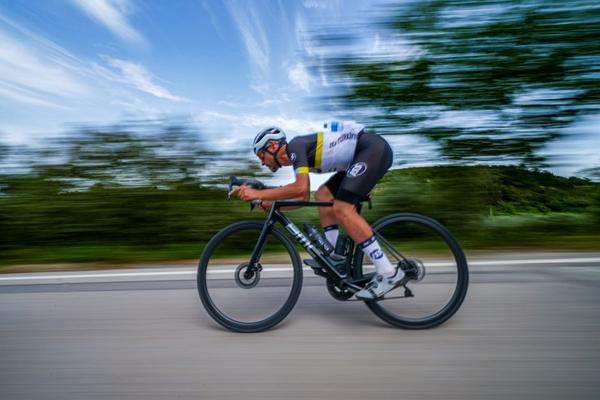
Watch cyclists approach a hill and you will see different pedalling rhythms. One spins quickly in an easy gear; another turns a harder gear slowly. Neither approach is automatically wrong. Cadence shapes how effort is shared between your muscles and cardiovascular system, and adjusting it can make climbing, cruising and long-distance pacing feel more controlled.
Cycling cadence explained simply is the number of complete pedal revolutions you make each minute. Understanding that number helps you use gears and terrain to find a rhythm that suits your body instead of chasing someone else’s figure.
What Does Cycling Cadence Mean?
Cadence is measured in revolutions per minute, or RPM. At 80 RPM, the crank completes 80 full turns in a minute. Count one foot returning to the top of its stroke, not both feet separately. Cadence differs from speed: you can pedal at 85 RPM slowly uphill or quickly on a flat road, depending on gearing.
To estimate cycling RPM without a sensor, count one leg’s full revolutions for 15 seconds and multiply by four. Twenty turns equal approximately 80 RPM. Only try this where conditions are safe; a sensor or indoor trainer is easier if watching the road requires your attention.
Why Rhythm Changes How Cycling Feels
At the same power output, slower cadence generally means greater force on each pedal stroke. Shift to an easier gear and increase cadence, and each stroke requires less force, although your legs move more often. That explains why grinding a gear may tire your thighs while fast spinning can challenge your breathing and coordination.
Pedalling efficiency is not just spinning faster. Very high cadences can raise energy expenditure, and laboratory measures of oxygen use do not always predict the rhythm a rider sustains best. Experience, intensity, duration and comfort matter. Cycling research supports flexibility rather than a universal optimum.
Is There an Ideal Cycling Cadence?
Many road cyclists use roughly 80–100 RPM on steady terrain, but this is a reference, not a rule. Recreational riders may settle below that range, while trained cyclists sometimes prefer higher rates. An ideal cycling cadence is one you can sustain smoothly at the required effort without excessive muscle strain or bouncing in the saddle.
Your preferred rhythm may change during a ride. A gear that feels pleasantly strong in the first 20 minutes could become tiring after two hours. Instead of forcing 90 RPM everywhere, notice when your legs feel overloaded or your stroke becomes frantic, and shift accordingly.
Adjusting Cadence to the Road
Flat roads and steady cruising
On a clear flat stretch, choose a gear allowing relaxed, even turns. If you push down hard and pause between strokes, try an easier gear. If your hips rock or you bounce, ease the cadence or choose a slightly harder gear. Aim for smooth pressure and a stable upper body, not a perfect reading.
Climbs and changing gradients
Hills often lower cadence because gravity demands more power. Shift before the gradient steepens and try to keep a manageable rhythm. A short, steep ramp may require slower pedalling even in your easiest gear. Low RPM is not a failure; notice how much force you apply and whether you remain comfortable.
Long endurance rides
On long rides, fatigue may reveal that your gear is too demanding. An easier gear can spare your legs during rolling sections, but unusually high RPM may also feel costly over hours. Reassess as conditions change. For further reading, explore endurance cycling pacing strategies.
Find Your Own Comfortable Range
Try this comparison on a quiet, level route or stationary trainer. Warm up for ten minutes, then ride three four-minute blocks at similar easy-to-moderate effort. First, pedal naturally. Next, choose a slightly easier gear and turn about 5–10 RPM faster. Finally, use a harder gear and turn about 5–10 RPM slower.
Keep speed or power as consistent as practical, and notice breathing, thigh fatigue, saddle stability and perceived effort. Recover gently between blocks. Headwinds, traffic or gradients can spoil outdoor comparisons, so repeat the experiment before drawing conclusions.
You might discover that 82 RPM feels settled while 95 makes you bounce, or that a higher cadence helps on gradual climbs. Those observations beat adopting an arbitrary number.
Cadence Training That Builds Control
Short, controlled spin-ups
On a trainer or safe unobstructed road, pedal easily and increase cadence for 20–30 seconds without substantially raising effort. Stop before bouncing. Return to your normal rhythm for a minute or two and repeat a few times. The aim is coordination, not a sprint.
Comfortable cadence changes
During an endurance ride, alternate a few minutes at your usual cadence with a few minutes roughly 5 RPM above or below it. Keep the effort conversational. Small variations teach you to change gears promptly and recognise when the rhythm stops feeling smooth.
Practise shifting before hills
Choose a familiar gentle incline and shift down just before it starts. Compare this with reaching the slope in a harder gear. Notice how early shifting affects momentum and breathing. This practical cadence training connects technique with handling. A guide to choosing bicycle gears can reinforce the habit.
Mistakes That Make Cadence Less Useful
Fixating on a dashboard number can distract from road conditions. Forcing high cadence in too light a gear until your torso rocks is not better technique. Repeatedly grinding a hard gear at high effort can also cause unnecessary muscular strain.
Bike fit matters. Saddle position and discomfort affect how natural a cadence feels. Persistent knee pain, numbness or unusual discomfort deserves attention rather than another drill. A basic bike fit checklist is a useful starting point, with professional advice if symptoms persist.
Frequently Asked Questions
Is 90 RPM the best cadence for cycling?
Not necessarily. Ninety RPM is common among experienced road riders, but the best rate depends on terrain, intensity, fitness and comfort. Treat it as a reference, not a compulsory target.
Is a lower cadence bad for your knees?
A harder gear at lower RPM usually increases force per stroke, but cadence alone cannot diagnose knee problems. Gearing, workload and fit also matter. Ease off if pedalling hurts and seek advice for persistent pain.
Can cadence training make me faster?
It can improve gear choice and control, which may help pacing. Research does not show that simply training at one prescribed cadence guarantees better performance.
Do I need a cadence sensor?
No. Sensors simplify comparisons, but briefly counting revolutions or noticing pedal rhythm can teach the basics. Safety matters more than collecting another metric.
Conclusion
Cadence is a tool for managing effort, not a score to maximise. Understand what RPM represents, experiment with nearby rhythms and shift early as the road changes. Your most useful pedalling rate keeps you balanced, comfortable and able to sustain the effort your ride requires.