A team can have talented athletes and still struggle to play well together. Individual ability matters, but team performance depends on timing, communication, trust, decision-making, and a shared understanding of what should happen next. Those qualities do not develop through speeches alone. They grow through purposeful practice.
The best drills to improve team performance recreate the demands athletes will face during competition. They require players to observe, communicate, adjust, and make decisions while under pressure. A drill should not simply keep everyone moving. It should teach a recognizable part of the game.
Although every sport has its own technical demands, the principles behind effective team training are remarkably similar. Well-designed activities help players connect individual skills to collective goals while giving coaches a clearer view of how the group functions.
Begin With a Clear Training Purpose
Before selecting a drill, coaches should identify the problem they want to address. A team that struggles to keep possession needs a different session from one that creates chances but fails to finish them. Without a clear purpose, practice can become a collection of unrelated activities.
Each drill should focus on one main objective. It may improve communication, defensive movement, passing speed, support play, transition awareness, or decision-making. Other skills will naturally appear, but the central goal should remain easy for players to understand.
Clear objectives also make feedback more useful. Instead of correcting every mistake, the coach can concentrate on actions connected to the session theme. This gives athletes a realistic chance to process information and improve during the activity.
Small-Sided Games for Faster Decisions
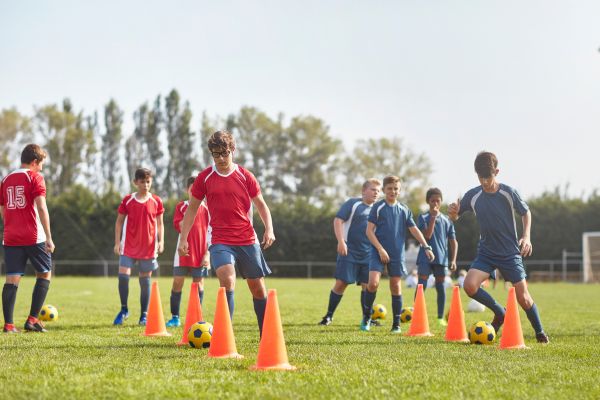
Small-sided games are among the most adaptable drills to improve team performance. By reducing the playing area and the number of participants, coaches give each athlete more opportunities to interact with the ball, teammates, and opponents.
The limited space naturally increases pressure. Players must scan earlier, communicate more clearly, and decide quickly. Someone who can hide during a full-sided game becomes much more involved when playing in a smaller group.
Coaches can adjust the activity to suit the desired outcome. A narrow area may encourage quick combinations, while a wider space may reward movement and switching play. Touch restrictions can increase passing speed, although they should be used carefully. If players are struggling to control the ball, strict limits may create frustration rather than learning.
The strongest small-sided games still resemble the real sport. Players should have direction, opposition, choices, and a meaningful way to score.
Possession Drills That Teach Support
Possession drills can improve passing, movement, awareness, and patience. Their value, however, depends on how they are structured. Passing in circles without pressure may help with technique, but it does little to develop the decisions required in competition.
Adding defenders creates a more realistic challenge. The players in possession must create passing angles, move after releasing the ball, and recognize when a safer option is needed. Defenders learn to work together, close space, and anticipate the next pass.
Communication should be encouraged throughout the activity. Useful information includes whether a player has time, where pressure is coming from, and which option is available. Coaches may need to model this language early, particularly with younger or less experienced teams.
Possession is not valuable simply because a team completes many passes. The drill should help players understand how keeping the ball can move opponents, create space, and prepare the next attacking action.
Transition Games for Quicker Reactions
Many important moments occur immediately after possession changes. Teams often become disorganized because players pause, complain, or wait for instructions. Transition drills teach them to react before the opportunity disappears.
A simple transition game can require the team winning possession to attack a new target immediately. The team losing it must recover, communicate, and protect the most dangerous spaces. This creates the mental shift that competition demands.
These activities should be intense but short enough to preserve quality. When fatigue becomes excessive, players may stop thinking and merely chase the action. Brief rounds with recovery periods often produce sharper decisions.
Coaches should watch what happens away from the ball. Does the nearest player apply pressure? Do teammates provide cover? Does the attacking team spread out quickly? Those movements often determine whether the transition succeeds.
Communication Drills With Limited Information
Players sometimes remain silent because they assume teammates can see the same picture. Communication drills show why that assumption causes problems.
One useful approach is to give different players access to different information. A player facing forward may need to guide a teammate whose view is restricted. In another activity, only one designated leader may communicate tactical instructions during a short game.
These limitations should not become permanent rules. Their purpose is to make players notice the value of clear, timely information. After the activity, normal communication can resume, and the team can compare the difference.
Coaches should emphasize the quality of communication rather than its volume. Constant shouting is not automatically helpful. Effective messages are early, specific, and relevant. Body language matters too. Pointing, eye contact, and movement can communicate intent before words are spoken.
Overload Drills for Recognizing Advantages
Overload situations give one group a temporary numerical advantage. They teach attacking players how to use an extra teammate and defensive players how to delay, cover, and protect important areas.
An activity might begin with three attackers facing two defenders. The attacking group must avoid rushing simply because it has more players. Good spacing, accurate timing, and patient decision-making are still necessary. The defenders, meanwhile, learn to communicate and force play toward less dangerous areas.
The coach can gradually make the challenge more realistic by introducing recovering defenders or a time limit. This changes the decision from “Can we attack?” to “How quickly must we use the advantage?”
Overload drills are especially effective because they reveal whether players recognize opportunities. An advantage has little value when teammates stand too close together or move at the wrong moment.
Scenario Training for Game Awareness
Teams need experience managing situations that do not occur evenly during ordinary practice. Scenario training allows coaches to recreate those moments.
A team may be asked to protect a narrow lead during the final few minutes, recover from a losing position, or play temporarily with fewer athletes. The score, time remaining, and tactical conditions should be clear so players can make decisions with context.
These drills develop emotional control as much as tactical awareness. Players learn when to take risks, when to slow the game, and how to remain organized when pressure rises. They also expose misunderstandings that might otherwise appear for the first time during competition.
Coaches should avoid controlling every decision. Let the scenario unfold, then discuss what the team noticed. Players often learn more by reviewing their choices than by following constant instructions.
Defensive Shape and Recovery Work
Strong defending is a collective skill. One player applying pressure is rarely enough if teammates do not move in support.
Defensive drills should teach the relationship between pressure, cover, balance, and recovery. As one player steps forward, others must adjust their positions. When the ball or point of attack moves, the entire group should respond.
The drill should include an opponent whenever possible. Movement without opposition can introduce positioning, but players eventually need to read unpredictable actions. Attackers should be encouraged to challenge the defense rather than follow a predetermined pattern.
Recovery runs deserve particular attention. Players need to know where to run, not merely that they should run back. Protecting central areas, identifying dangerous opponents, and communicating assignments can turn a desperate recovery into an organized response.
Competitive Finishing Under Pressure
Finishing drills often look impressive when there is no opposition. In a match, however, athletes must execute while tired, rushed, and challenged by defenders.
Competitive finishing activities introduce pressure gradually. A defender may begin from behind, approach from an angle, or enter after the attacker’s first touch. Teammates can create additional decisions by offering passing options.
The objective is not to make every attempt difficult. Players still need repetition and confidence. The challenge is finding a balance between technical practice and realistic pressure.
Keeping score can add intensity, but competition should support the learning goal. If players begin taking poor attempts simply to finish quickly, the rules may need adjusting.
Reflection That Connects Practice to Competition
A drill becomes more valuable when players understand what it taught them. Short pauses can help the team identify patterns without draining the energy from practice.
Coaches can ask what made an activity successful, where space appeared, or how communication changed the outcome. These questions encourage athletes to think rather than wait for answers. At the end of the session, the group should be able to connect the drills to situations they expect in competition.
Reflection also helps coaches. If an activity did not produce the intended behavior, the problem may lie in its size, rules, difficulty, or explanation. Adjusting the design is often more effective than blaming players for failing to understand it.
Building Better Teams Through Purposeful Practice
The most useful drills to improve team performance are not necessarily complicated. They create realistic problems, keep players involved, and connect technical skills with collective decisions. Small-sided games, transition activities, overload situations, defensive work, and scenario training all become more effective when they serve a clear purpose.
Improvement rarely comes from one brilliant session. It develops through consistent practice in which athletes are challenged to communicate, adapt, and take responsibility. When drills reflect the real demands of competition, players begin to understand not only their own role but how that role supports everyone around them. That is where a collection of individuals starts to become a genuine team.